
Cart
Qty:
Loading...

Qty:

In celebration of their sixth anniversary, Modbap has introduced oneTHNG Fidelity Theory: a plugin designed to explore uncharted corners of the sonic language of classic sampling technology.
That's a lot to unpack, but you heard us right—Modbap, which up until now has operated purely in the Eurorack modular synthesizer space, has introduced a software-based audio processor. What's more, it's just the first in a series, and we expect even more releases as time goes on. Named "oneTHNG," this series aims to put extensive sonic control behind simple, intuitive user interfaces. Ultimately, the goal is to cut past the complexity of maximalist user interfaces and get straight to what matters: artists following their intuition and using their ears to make musical decisions.
Fidelity Theory in particular presents the user with single-knob control over a variety of audio degradation processes. This can sometimes approximate the character of classic sampling technology, but at other times, presents as-of-yet unheard combinations of sample rate, bit depth, aliasing, and converter characteristics. It's not a direct emulation of a vintage sampler: instead, it extends the language of digital audio's idiosyncrasies, creating dynamic new sounds along the way.
We took the opportunity to talk with Modbap founder Corry Banks. Of course, we've been following Banks's work for years—from his music tech blog BBoyTechReport to his label BeatPPL as well as his hardware development endeavors. Those familiar with Banks will know that he's also a central figure to the hiphop subgenre/scene which he named "modbap": essentially, a raucous spinoff/take on boom bap focused on the use of modular synthesizers. Banks has both grown this scene by fostering modular-focused hip-hop artists as well as developing his own tools, bringing a much-needed, fresh and vital voice into the Eurorack scene.
Be sure to get your copy of oneTHNG Fidelity Theory—it's completely free through 10/12. Check out the full interview below, and stay tuned for more from Banks + Modbap.
[Article banner image courtesy of Laith Majali]

[Above: Corry Banks, founder of Modbap. Photo credit David Sprague / Los Angeles Business Journal]
Ryan Gaston: Hey Corry! Thanks for taking the time to talk with us. This is the first time we've interviewed you, so I thought we'd just sort of catch up on Modbap, talk about where you're coming from, and generally get up to speed with your work before diving into the new release. So let's start with some foundational questions: can you tell us about where you come from, musically? How did you get your start making music? What were some early formative experiences listening to music?
Corry Banks: I think where I come from musically has a lot to do with where I actually come from, which is Chicago. Chicago obviously has this rich history of blues and soul, but I came up in the ’90s, when house music was everywhere, even with my stronger interests in all things hip-hop. That informed my childhood, but I was always more enamored with hip-hop. I would always stay up late to catch college radio for the latest hip-hop from NYC.
As far as actually making music, that came out of necessity. I was an artist first. I was in a hip-hop group in Chicago in the ’90s, and I started learning to produce because I wanted to rap over the beats I wanted to rap over. Eventually the beat making became the primary interest.
So, I think it was really all of those things together: Chicago, hip-hop, house music, the culture of both hip-hop and house, and this curiosity about the machines people were using to make all of it.
RG: Before Modbap Modular came around, I knew you as the guy behind BboyTechReport and BeatPPL. Can you tell us a little bit about these projects? How did they get started, and what categories of your work fall into each “bucket?”
CB: BboyTechReport came first. It was my blog. I had gotten really deep into music production and music technology, and friends were constantly asking me what I thought about different gear. I realized I was giving my opinion about this stuff all the time anyway, and I actually enjoyed doing it, so I thought, why not start a blog?
Another part of it was that I just didn’t hear many voices like mine in that space at the time. There were a couple people representing hip-hop and beat making in music-tech media, but nothing like what exists today. I wanted a voice like mine to be part of the conversation.
That opened a lot of doors. I got to review some really dope gear, interview legends in music technology, go to trade shows, and eventually beta test for major companies. A lot of things that came later can be traced back to BboyTechReport.
[Above: Banks's track "Hawk Eye" from Diggin' in the Wires, Vol. 1, released 2021 on BeatPPL.]
BeatPPL became another bucket for the creative side. It was my music label, so I released beat tapes, instrumental projects, collaborations, and sound-design products through it. It’s also where I released Diggin' in the Wires, the Modbap compilation with around 20 artists exploring that intersection between beat making and modular synthesis.
BeatPPL was also the name of my podcast for a few years. I could see media moving from blogging toward podcasting, and frankly, we had some things to talk about. I got together with friends I would see every year at NAMM and turned those conversations into a show. That eventually led to Trovarsi and me doing a short live Perfect Circuit show for a summer.
So BboyTechReport, BeatPPL, the podcast, all of those things kind of fed one another. BeatPPL also eventually became the parent company for Modbap. In the early days I would actually refer to the company as “Modbap Modular by BeatPPL.”
RG: How did your interest in Eurorack begin, specifically? Was it as a gear reviewer, a concertgoer, or just getting your hands on a modular synth?
CB: I had always been interested in synthesis and in bringing synthesis into beat making, but for a long time I was much more into traditional fixed-architecture synthesizers.
Eurorack kept showing up around me, though. I had friends who were deep into modular, I was seeing more of it through BboyTechReport and trade shows, and the more I learned about synthesis, the more I started understanding why modular was interesting.
I resisted it for a while. Then I finally got into it and realized something I didn’t expect: modular actually taught me more about synthesis. I thought I understood synthesis pretty well before, but when you have to patch those relationships yourself, you start understanding what’s actually happening in a different way.
The other thing that made me curious was that I wasn’t seeing a lot of people using modular in the context of the kind of beat making I was doing. I had friends like Shiro (Voltage CNTRLR), Ken (Flux), and Bryce (Upright) incorporating modular into their music, but even among us, everybody made very different hip-hop music. That made it even more interesting to me. I started wondering, what does modular sound like when I bring it into my process?
So, I started integrating Eurorack with my regular beat-making hardware and exploring that.
RG: Tell us about Modbap, as a genre / scene. We understand you coined the term, is that right? Was that because there was a particular direction that you wanted to push modular synths and/or boom bap? Or because you were noticing that a collision of these worlds was already naturally emerging?
CB: Yeah, I literally made the word up. Modular Boombap. Mod Bap. Modbap.
Once I started incorporating modular synthesis into my beat-making process, I started posting those beats online and calling what I was doing “Modbap.” I thought the word sounded cool, and somehow, it stuck.
There wasn’t some big manifesto behind it. But I had friends doing things in that same general intersection, and it started to feel like maybe there was something there. Then other people started using the descriptor, and a community began forming around the idea. It became sort of this umbrella type of term for what some of us were doing by incorporating modular into our beatmaking process.
[Above: Shiro Fujioka aka VoltageCtrlR's track "Inner Siddhi Vortex" from Diggin' in the Wires, Vol. 1, released 2021 on BeatPPL.]
That eventually led to Diggin' in the Wires, which is probably one of the things I’m most proud of from that era. We were able to bring together a group of artists around this idea of modular synthesis and beat making and hear all these completely different interpretations of what that could mean.
So Modbap became bigger than whatever I originally intended when I typed the term in a caption under a beatmaking post. I didn’t necessarily want to define what the music had to sound like, either. What interested me was that Eurorack felt like this wide-open space where I wasn’t hearing a lot of boom bap or beat-oriented hip-hop aesthetics. I wanted to explore that territory. It all happened very organically.
It reminds me a little bit of BboyTech. BboyTechReport was supposed to mean B-boys using technology and reporting on it. Because it was basically just me, people started calling me BboyTech.
Modbap kind of did the same thing. I named a thing I was doing, and eventually that name took on a life of its own.
RG: Who would you say are or were some foundational artists in that scene? What/who should we listen to to understand the Modbap sound or spirit?
CB: I think you’d have to mention VoltageCtrlR, myself as BboyTech, and Ski Beatz. Those are people who were putting out projects that either explicitly identified with Modbap or really explored this collision between beat making and modular synthesis.
You could probably pick almost any VoltageCtrlR project from that era and hear it.
[Above: Ski Beatz's track "Air Ride" from Switched On Bap, released 2018.]
Ski Beatz’s Switched On Bap is another obvious one. It was his nod to Wendy Carlos’s Switched-On Bach. Ski got deep into modular and made this record that still had the foundation of boom bap, but modular synthesis became part of its vocabulary.
And again, I’d point people toward Digging in the Wires. There are around 20 artists on that record, so rather than hearing one definition of Modbap, you hear this really wide swath of interpretations.
I’d also include my projects Synthbap and King Rising, and another called Art of Intelligence where I collaborated with Upright and DAP (rest in paradise Dap).
Those records together probably give you a pretty good picture of the spirit of it.
RG: What about your technical background? Do you have training as a hardware engineer? In DSP? What inciting events, motivations, or factors led you to decide to start a Eurorack company?
CB: Yeah, I have a degree in electronics, and I’ve always been a tinkerer. I was that kid who pulled things apart and put them back together. Somebody could be throwing out an old stereo or an air conditioner, and I would figure out how to get it working well enough to use in my own room. Built a little studio apartment museum of refurbs in there.
There were other little clues along the way too. In the early 2000s, I was part owner of a company building clone computers, and part of our intention was to build computers for people making music. Years later, a friend and I talked about creating an electronic instrument. We didn’t get much further than drawings and plans, but I kept ideas like that close: always making notes, drawings, product concepts etc. Prior to that I’d earned a degree in electronics and found my way into tech.
But I wouldn’t say my electronics background is why I started Modbap. It was really the accumulation of everything else. My electronics background became almost a side note or a backdrop thing of my past life.
I was making music with modular. I was blogging about music technology. I was going to trade shows and developing relationships in the industry. I was doing reviews and beta testing products, and through that process I started realizing that some of my ideas could actually become viable products. You learn a lot just by being around this stuff long enough. Eventually I had actual designs, specs, relationships, and a better understanding of how to put the pieces together. I could also see a space in the market for products with a different kind of voice.
Then I found myself in a position where I could invest in the idea and decided to bet on myself. I already had things I wanted to make, and I knew I could bring the right resources and people together to help me make them real. At that point I felt like if I didn’t do it then, I might never do it.
RG: Is Modbap Modular more or less a solo venture, or are you collaborating with others on conceptualization, firmware, etc.? Why was Per4mer the right place to start as an initial product offering?
CB: Modbap is a solo operation. But in the spirit of founder life and entrepreneurship, I work with vendors, contractors, developers, and other subject-matter experts where needed to bring a complete product to market. That’s part of building products. You define what you want to make, and you put the right resources around it to execute the vision.
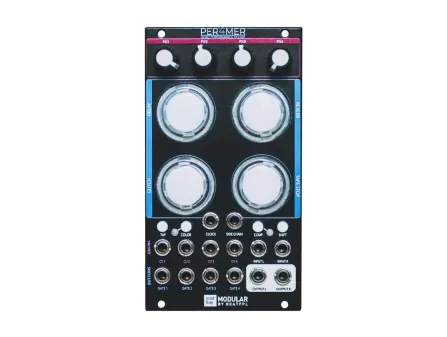
As for Per4mer, when I decided to make the leap, I actually had three module designs that I wanted to release at the same time. Part of me thought, I don’t know if I’ll ever get another chance to do this, so let’s make all three. Then reality set in and I realized I needed to choose one. Per4mer was the most differentiated of the three and it just sort of made sense.
Aesthetically, functionally, and interactively, it was the one that immediately stood out. At the time, I didn’t see a lot of Eurorack multi-effects modules, and certainly not many that you interacted with in that kind of performance-oriented way. I remember thinking, if I only ever make one module, I want it to be something you can recognize from across the room in somebody’s rack. Per4mer was that.
It also connected directly to the way I made and performed music because I had always used DJ-style performance effects. So it became the obvious first statement. And funny enough, the other ideas from those original designs eventually made their way into products too.
RG: Do you have a favorite among your own designs? Does that, or how has that, changed over time?
CB: Per4mer is probably still my favorite. It has sort of become the quintessential modbap object, so to speak. Part of it is aesthetic. I love that it combines these cultural references from arcade games and beat making in a space where neither of those were well represented that way.
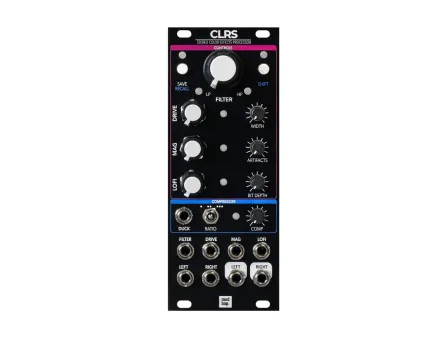
There have definitely been periods when I would have said Trinity is my favorite. Even now it depends on the day that you asked me but Trinity is definitely up there. Honestly, whatever module I had just finished tended to become my favorite for a while. You spend that much time with something, and you’re excited about the new ideas in it. Oh, also CLRS is such a dope module. It’s like a beatmakers channel strip in eurorack format.
But with some distance, Per4mer and Trinity are probably the two that have stayed closest to me.
RG: Among users of your products, can you point out a few favorites? Whose music should we be checking out to get a sense of the Modbap Modular vibe?
CB: A few years ago at NAMM, I did something that probably answers this question better than me just giving you a list of artists.
I invited four artists to perform at the Modbap booth: Ali The Architect, Voltage CNTRLR, Ken Flux Pierce, and Fess Grandiose. Months before NAMM, I sent each of them the full Modbap product line and basically said, put this into your system and come do your thing.
What I loved was that you could give all four people the same modules and get four completely different performances back. They didn’t make the same music. They didn’t even necessarily approach the gear the same way.
That, to me, was an incredible demonstration of what I want these products to be. They should have a point of view, but they shouldn’t dictate your point of view.
Those performances are actually still up on the Modbap Modular YouTube channel.
I’d also put Ski Beatz and Frenchie the Glorious Bastard on that list. There are a lot of different ways people have interpreted the Modbap ecosystem, and I love that.

RG: Of course, we're talking to you today because you've just announced Fidelity Theory, the first official Modbap software offering. So, let's talk big picture first. Why start making software? And why now, in particular? Was this a decision about business practicality? Accessibility? About serving a specific audience?
CB: Plugins were actually part of the plan from the beginning. When I started Modbap, I never imagined it being only a Eurorack company. I always wanted the brand to eventually expand into software and desktop instruments too. As a matter of fact, I’ve been developing a desktop semi modular instrument for a while now. Only 2 and a half of them exist in the world today.
But as for plugins? It just took me longer to get there than I expected.
For a while I got into this rhythm of developing and releasing eurorack hardware every year, and hardware demands a lot of attention. So, software stayed on the roadmap while I concentrated on building out the Eurorack side of the company. Eventually there came a point where I had the ideas, the opportunity, the resources, and the right people around me to really focus on it. It just felt like, okay, now is the time to finally execute this part of the dream.
So, it wasn’t a sudden decision to start making plugins. It was something I had wanted Modbap to grow into from the beginning. Also I like what software does for the brand. It lets me take the ideas and perspective behind Modbap beyond one hardware format and put them in front of musicians who may never own a Eurorack system. It allows me to express Modbap ideas on a different canvas.
Fidelity Theory is actually the first release in a whole series called oneTHNG, and there are two more oneTHNG releases coming this year. But Fidelity Theory is the anniversary release for our sixth anniversary on October 10th of this year.
So this isn’t one plugin. It’s the beginning of another part of Modbap expressed through a different medium.
RG: So, give us some more specifics about Fidelity Theory; what is it, why is this specifically the first software you wanted to put out into the world?
CB: Fidelity Theory is the first plugin in the oneTHNG series, which is really about taking a focused approach to texturizing and lo-fi effects.
The basic philosophy is right there in the name: one theory, one knob, one thing. I didn’t want to start the Modbap software catalog with something where you open the interface and there are 40 controls staring back at you. I wanted these first tools to be immediate.
With Fidelity Theory, the theory is about the relationship between bandwidth and resolution. Sample rate and bit depth.
The main knob controls sample rate and bit depth, but instead of giving you two independent controls, they move inversely to one another. Think of it like a seesaw. One goes high, the other goes low. As the sample rate goes up, the bit depth comes down. As the bit depth goes up, the sample rate comes down.
So you can’t have both at maximum fidelity, and you can’t have both completely destroyed at the same time. That creates all of these sweet spots and combinations across the knob where you land on different coordinates that introduce textures and kinds of character.
You can put it on drums, samples, individual tracks, a bus, whatever. You turn the knob, find the character you want, and keep moving. Its that one thing that a source may be missing. oneTHNG: Fidelity Theory lands with quick access and even quicker dial to your tastes. It’s turned into a go-to for me.
That felt like the right way to introduce Modbap software because oneTHNG is really the on-ramp into a much larger catalog we’re building.

RG: Naturally, one of Fidelity Theory's boldest design decisions is to put so many sonic variations behind a single, essentially nonlinear knob control. Can you explain the logic behind how all of those distinct sonic characters are organized behind a single control? And, why set it up that way rather than giving users more direct control of, say, sample rate and bit depth reduction? What is gained with this type of minimal user interface?
CB: It feels like everything is so maximalist right now. More parameters. More pages. More modulation. More options. And listen, there’s absolutely a place for all of that. But sometimes I don’t want making music to turn into a science project. When I’m creating, I don’t want the technology to become an impediment to creativity. I don’t want to stop making music because now I’m engineering the plugin. This is an easy way to get technology out of the way and keep the creative flow moving.
For me, a really well-designed tool lets you make a decision quickly. That doesn’t mean there isn’t complexity underneath it. It means somebody made decisions about the complexity before it got to you. That’s what oneTHNG is about.
With Fidelity Theory, I wanted to be able to turn one knob and continually hit useful territory. If I want more character, I can add Coil or Ring. But I shouldn’t need to stop and tinker with or think about 15 parameters just to make something sound dirtier.
Turn the knob. Hear it. Decide. Keep creating.
I actually think of these oneTHNG series of effects as bread-and-butter effects, even though they aren’t traditional bread-and-butter effects. They become bread and butter because they’re quick, decisive, opinionated, and easy to reach for.
RG: Tell us about the Coil and Ring settings; how do they work + how do they impact the sound?
CB: Coil and Ring let you add another layer of character on top of wherever you’ve landed with the main control.
Coil is really about converter characteristics sort of. Iron gives you more of that saturation-stage character you might associate with going through the converters of a machine, a preamp, or an older sampler. Then you can switch Coil over to Worn, which is more like an aging converter stage. It still has saturation, but it gets darker and there’s a little more asymmetry to the character. It’s worn. It’s aging. It’s heavier and darker. That’s the point.
Ring is different. There was a certain old gray box that a lot of us used to sample with back in the day. I’m not going to name it. We’ll just call it the gray box. Depending on how you sampled into it and how you had things configured, you could get this aliasing character that became part of the sound. Ring is our way of bringing that layer into Fidelity Theory. So wherever you are on the main knob, and whichever Coil profile you’re using, you can hit Ring and introduce another layer of aliasing on top of it.
You really hear it on melodic material, samples, vocals, and material with a lot of mid and high-frequency content, but it affects the low end too. And it's nice and pleasing and / or big and destructive depending on the material and the coordinates that you land on with the knob.
It’s another way to make things a little warmer, a little grungier, and a little more imperfect.

RG: To what extent would you say that Fidelity Theory about modeling the sound of specific vintage samplers, vs. using the language of techniques like sample rate reduction / bit depth reduction to create new sounds?
CB: That’s a really good question because Fidelity Theory isn’t intended to be a model of one particular vintage sampler. I wanted it to be able to get into those neighborhoods without necessarily being a recreation of one specific box.
Sometimes when people talk about old samplers, the conversation stops at sample rate and bit depth. That’s obviously a huge part of it, but it wasn’t the entire sound. There were converters abd other hardware stages. There was saturation. There was aliasing. There were all these other characteristics of the actual machines. That’s why Fidelity Theory has Coil. That’s why it has Ring. With those things combined with the sample-rate and bit-depth relationship, you can absolutely get into the territory of some old beige boxes and old gray boxes. In some cases you can get pretty close.
But I was just as interested in the boxes that never existed. That’s where the diagonal relationship becomes interesting. What does an imaginary sampler sound like at 46 kHz and six bits? What happens at 36 kHz and 10 bits? There may never have been a piece of hardware designed around those combinations, but why shouldn’t we hear them?
That’s one of the things software makes possible. We don’t have to stop at recreating history. We can take the language of those old machines and ask new questions with it. And really, that’s why I like the word Theory for this oneTHNG series of plugins that we are dropping this year.
The plugin starts with this theory: what happens if sample rate and bit depth are tied together like a seesaw, almost like magnets in opposition to one another? Then you turn the knob and find out.





Welcome back
You're signed in.
Go to my accountWelcome to Perfect Circuit
Your account is ready.
Start exploring gear, save your favorites, and manage your orders from your account.
Go to my accountCheck your email
We've sent you a link to confirm your email address. Confirm it to finish creating your account.
Or continue with
No account? Sign up for free
Already have an account? Log in