
Cart
Qty:
Loading...

Qty:
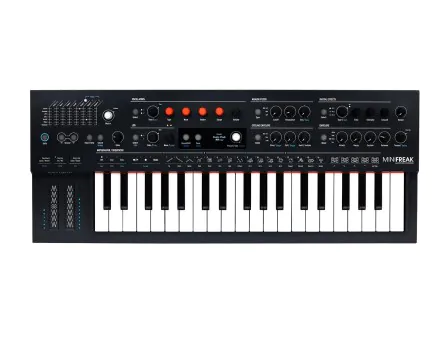
As if Arturia's lineup wasn't already freaky enough, they went and did it again: the Minifreak 49 is here, offering a full-size entry into their wild (and wildly popular) line of hybrid synthesizers. And, happily, it's a Freak through and through. Like its predecessors, it features unhinged digital sound generation paired with analog filters, wide-ranging effects, and special methods of interaction sure to appeal to even the most experimentally-minded among us. And, as with the Microfreak and Minifreak before it, it packs a surprising punch for its price range: at a mere $799 as of publishing this article, it is a nearly no-contest contender for the best synth in its price range.
If you're familiar with the Freak series, a quick explanation should suffice: Minifreak 49 is a direct extension of the lineup, embodying all the firmware features of other members of the family, but packaging them in a full-size 49-key instrument. It also features a number of new tricks all its own, including a multi-function touch surface, conventional mod wheels, monophonic aftertouch, and more. It's fully compatible with Minifreak presets; so, it's the same sound and unusual architecture we know and love, with a refactored user interface designed for serious live performance.
For those that aren't already familiar, let's take a high-level look at its capabilities, and think through the implications of some of its new features.
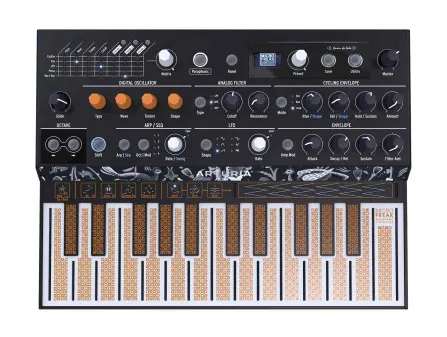
The Freak series began in 2019 with the release of the wildly popular (and wildly flexible) MicroFreak. Still the smallest entry in the family, MicroFreak was a sort of litmus test for the public. Arturia needed to determine if their unusual plans for a family of hybrid synthesizers could work—and sure enough, the instrument-enjoying public was more than ready to embrace their unusual combination of digital and analog features. From the outset, the idea has been to pair highly flexible digital sound generators with analog filtering and unusual approaches to interaction. The MicroFreak achieved this by using a paraphonic architecture: multi-modal digital oscillators running through a single analog articulation path, allowing for the odd combination of advanced digital synthesis with true organic analog filtering in a remarkably small and affordable package. It was, of course, a hit.
This was followed by the MiniFreak in 2022, which took the groundwork of its forebear and turned it into a much more flexible and powerful instrument. Gone was the paraphonic architecture, replaced in favor of true polyphony: six voices with two digital oscillators and analog filtering, followed by a deeply flexible multi-effect processor. Providing immense sonic flexibility and true analog filtering at a price point typically reserved for entry-level digital synthesizer, MiniFreak made a huge splash, and continues to be one of the most popular synthesizers that we sell.
One of the most important aspects of the Freak series to consider is its extensibility. Over the years, these instruments have seen an astonishing number of free firmware updates. We're not just talking about bug fixes or simple quality-of-life improvements; firmware updates often include entirely new sound generation engines, effects, and fundamental changes that add unfathomable sonic depth to an already-powerful instrument. Arturia promises that this spirit will extend to the new MiniFreak 49. So, if you're reading this in the future, take what we're saying as a point of departure. From here on out, we're talking about what MiniFreak 49 is today, but no doubt, it will turn into something much more in the future.
MiniFreak 49 carries the original MiniFreak's strengths forward: it features two digital sound generator engines and analog filtering for each of its six voices. It adds a new preset library, and includes a license for the MiniFreak V software: allowing you to take the Freak sound engine with you, even into the virtual realm. It adds a host of new features: 49-key full size keybed with mono aftertouch, voice panning, and a new multi-touch XYZ matrix for modulation assignment, preset navigation, and realtime control.
The heart of the instrument is, of course, the sound generators. Each of its six voices includes two digital sound generation engines. You can think of these as being similar to oscillators, but each has a variety of modes that can take them well beyond oscillator-like behavior. Each offers over 30 distinct modes, ranging from conventional Virtual Analog and wavetable engines to resonators, FM, speech synthesis, a variety of granular synthesis and processing tools, sampling, and much more. The second oscillator/engine can, in some cases, even be used to process the first before the filter stage, generating an immense level of complexity and sound design potential. Special algorithms contributed by Noise Engineering and others adapted from Mutable Instruments code add an even deeper touch of boutique sonic strangeness to your palette.
The instrument's filters impart warmth and colorful tone-shaping on the deeply flexible digital core. Each voice has its own independent resonant filter, with low pass, band pass, or high pass states. Their resonance goes up into self-oscillation, allowing you to use the filters as a sound source or analog resonator in their own right; and you can even apply audio-rate FM to the filters for more complex sound design possibilities.
Modulation is just as complex and inspiring as the sound generation itself. You get two LFOs with selectable waveforms—including a custom shape editor and the capability to draw waveforms on the matrix display. You also get polyphonic cycling envelopes, and the new touch matrix allows for easy assignment of modulation sources to destinations, even as you play.

The end-of chain effect processing includes three slots with thirteen algorithms each, including everything from straight-ahead delays and reverbs to external vocoding, internal spectral processing, unusually deep modulation effects, distortion, equalization, compression, and more. These allow you to take your sound and truly sculpt it, allowing a fine level of finesse...or, of course, you can use the effects to completely blow everything apart.
As before, the onboard sequencer and arpeggiator bring additional animation to your sound. The sequencer includes four modulation tracks, which can be assigned to most parameters, creating unusual rhythmic modulation that transforms your sound as it plays. But performative control just got a lot deeper, as well: the multifunction XYZ touch matrix can be used as a visualizer, as an interface for the modulation matrix, or as a so-called Freak Control source, enabling touch-controlled macros, gate, and Spice control, as well as pre-mapped multitouch controls for your oscillators engines, filters, and more. It's an intuitive way to reach out and touch your sound, truly adding extra dimension to your performances. Add the velocity and mono aftertouch-capable keybed and you have the most expressive member of the Freak family yet.
Of course, as with the MiniFreak before it, MiniFreak 49 includes the MiniFreak V software, and can act as a complete control surface for the software, providing hands-on control of the virtual extensions of your freakishness.

Putting marketing hype and "freak" terminology aside for just a moment, I'll offer you my direct and genuine perspective: MiniFreak 49 is essentially an expanded version of the standard MiniFreak, coming in at an only slightly higher price. As of the time of publishing this article, the original MiniFreak retails for $599 USD, and the MiniFreak 49 for a mere $799. For those additional $200, you get a full-size keybed, conventional pitch and mod wheels (vs. capacitive touch strips), a new touch matrix, individual voice panning, and an overall more robust-feeling package.
The fact of the Freak series has always been this: they are astonishingly affordable instruments for what they offer. Some sound engines may lack the depth that a seasoned sound designer might expect, but the sheer range of sonic possibilities is certainly enough to keep you busy, and for a musician who needs to prioritize sonic range as part of their purchasing decisions, any member of the Freak family should prove to be a great value. As for whether the $200 price jump from MiniFreak to MiniFreak 49 is worth it...that's obviously a personal decision, but for me, it feels like a very sensible value proposition, and I'm admittedly a bit surprised that it doesn't cost more.
For me, the most interesting and legitimately new feature in the 49 is the touch matrix. XYZ pads are sort of a mixed bags in terms of their efficacy as performative control sources, but this one goes a bit farther than the norm. Its use as a macro control source is quite interesting, and the premapped parameter options should allow for easy and quick control. I'm perhaps most interest in its use as an interface for the internal modulation matrix. Historically, synthesizer modulation matrices are quite fiddly menu-based affairs, and I appreciate that they've taken an approach somewhat similar to the MatrixBrute, allowing for quick and easy visualization and edition of the instrument's modulation paths. This brings one of the most important aspects of the synthesizer's sound design possibilities to the forefront: it's not just about fancy synthesis methods, but about how you change they way the instrument behaves over time and in response to your playing.
My feelings are quite clear; MiniFreak 49 is an astonishing value, providing an essentially bonkers number of features for its price and outperforming many other instruments in its price range in several respects. It's a respectable option for any synthesist looking for a serious, powerful instrument, and I'm eager to hear what everyone does with it.





Welcome back
You're signed in.
Go to my accountWelcome to Perfect Circuit
Your account is ready.
Start exploring gear, save your favorites, and manage your orders from your account.
Go to my accountCheck your email
We've sent you a link to confirm your email address. Confirm it to finish creating your account.
Or continue with
No account? Sign up for free
Already have an account? Log in